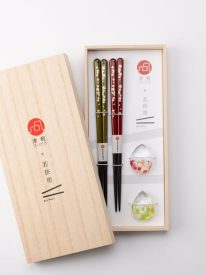
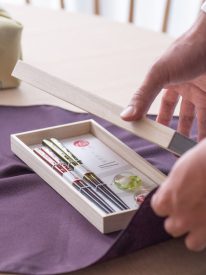
This gift set brings together the craftsmanship of Tsugaru Vidro from Aomori Prefecture and Wakasa lacquerware from Fukui Prefecture. Featuring a delicate cherry blossom design, the handles are painted in an attractive deep red or green hue. The moment you hold the chopsticks in your hand, you can truly appreciate the quality of authentic craftsmanship….
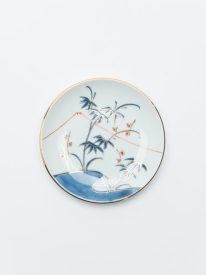
This sauce plate features a refined bamboo motif alongside an iconic depiction of Mount Fuji. In Japanese culture, bamboo is esteemed as an auspicious emblem that signifies longevity, and robust health. The technique displayed in this plate is called somenishiki where the plate is first glazed with white and blue patterns and then is further…
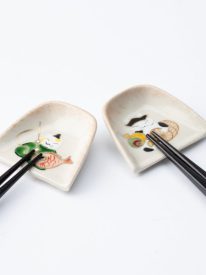
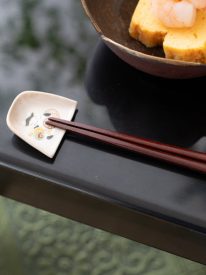
This set features chopstick rests in the shape of a traditional straw cape, portraying cats dressed as Ebisu and Daikokuten, two of the Seven Lucky Gods. Ebisu, the god of fishermen, is known as the deity of prosperous business. He is depicted holding a sea bream in his left hand and a fishing rod in his right,…
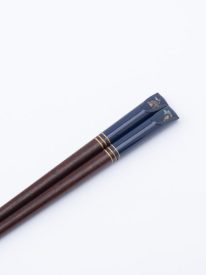
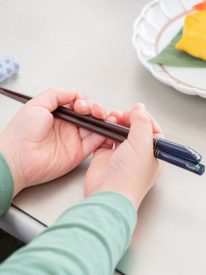
These are children’s chopsticks made of natural wood and lacquer. The top part of the chopsticks is a deep navy color and is adorned with a gleaming rabbit motif made of natural abalone shell. Three gold rings accentuate the transition into the rich brown color of the lacquered wood. The size is suitable for children…
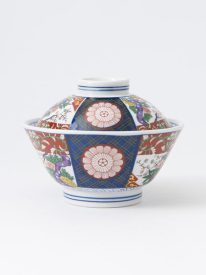
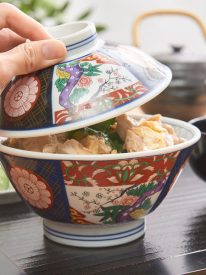
This small-sized Japanese donburi rice bowl features peonies, framed by dark blue, lattice-like patterns, all rendered in the traditional nishiki-e style. Nishiki-e, meaning “brocade picture,” is a multi-colored woodblock print technique that revolutionized ukiyo-e during the Edo period (1603-1868 CE), when most prints were in black and white. The lid helps keep the food warm and…
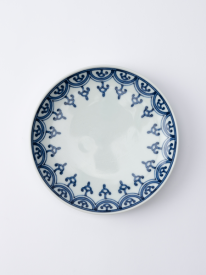
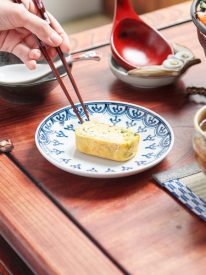
This round side plate is crafted by Takayama Toki, a renowned maker of Hasami porcelain, and dyed with seitan, a kind of indigo. It features a finely detailed yoraku design along the rim, an intricate pattern that originates from luxurious ancient Indian necklaces and ornaments. Traditionally, this pattern has been cherished as an auspicious symbol…
A fun bowl featuring a playful decoration of a little man soaking in a bath, which appears when you pour soup into it. The traditional pattern drawn on the bowl creates a unique combination with the whimsical design, serving as a perfect example of Choemon’s ability to blend traditional and modern elements into tableware. Originally…
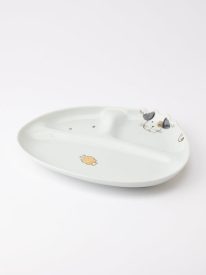
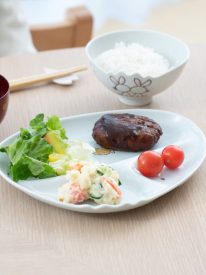
Serve meals to your little ones in this cute and well-designed children’s plate. Kids will love seeing the dog peeking from the rim of the plate. His ears are neatly shaped on the edges to give the plate a unique shape. The plate is divided into 3 sections. The bigger section can be used for…
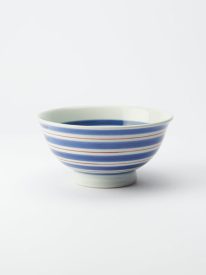
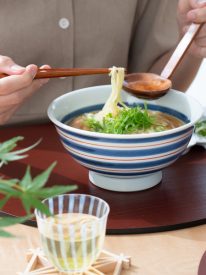
Thick blue and fine red lines alternate around the whole exterior of snow-white porcelain of this donburi bowl. The blue lines are drawn using the traditional gosu pigment, while the red accents enhance the design. The hand-painted blue patterns are made using the tsuketate technique, where each stroke is applied without outlines. This gives the bowl…
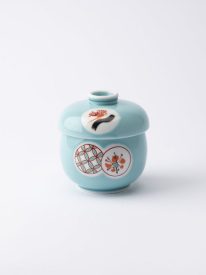
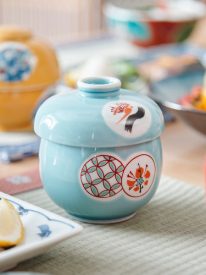
This chawanmushi (Japanese steamed egg custard) bowl has a traditional circle pattern called marumon. The transparent blue-green color unique to celadon porcelain is beautiful and contrasts elegantly with the red circle pattern. Tasei Kiln is a kiln that originally made chawanmushi bowls for restaurant use. If you make chawanmushi with it, you can enjoy authentic…
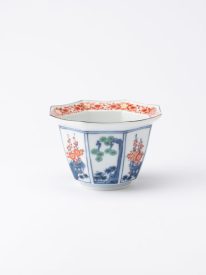
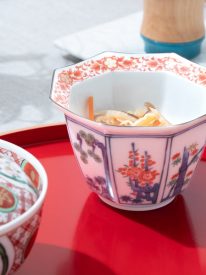
This kobachi small bowl is decorated in the Kakiemon style. The Kakiemon style is known for its elegant compositions that use blank spaces to highlight the porcelain’s beautiful milky white color, with delicate depictions of flowers and birds in natural landscapes. The bowl has an octagonal shape with an outward-extending rim. Its depth makes it…
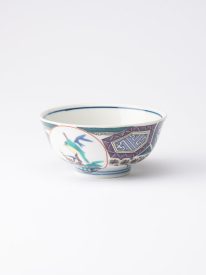
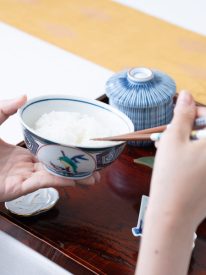
This Japanese rice bowl has a typical design of the Ko-Kutani (old Kutani) style dating back to mid-17th century, depicting the nature-themed motif and traditional patterns and distinctive bright colors of Kutani ware. It is painted with the five colors of red, yellow, green, purple and dark blue, known as “Go-Sai” in Japanese. Kutani ware uses…

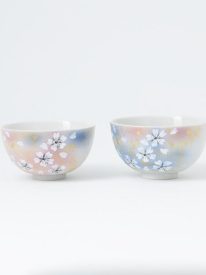 Flower Dance Kutani Japanese Rice Bowl Pair
 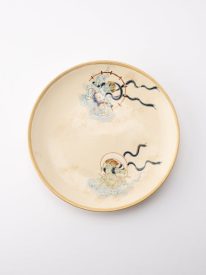 Tosen Kiln Wind God and Thunder God Kiyomizu Ware Plate 9.4in
 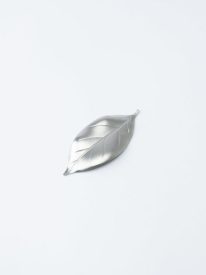 Tsubame Hutlery Silver Camellia Leaf Chopstick Rest
 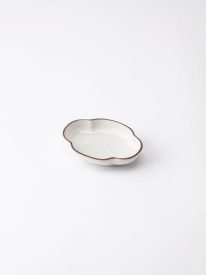 Hachi-Kutani Flower Birds Guard Sauce Plate
 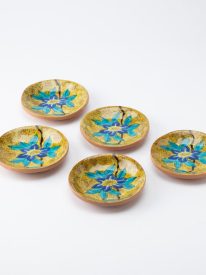 Yoshidaya Clematis Kutani Sauce Plate Set